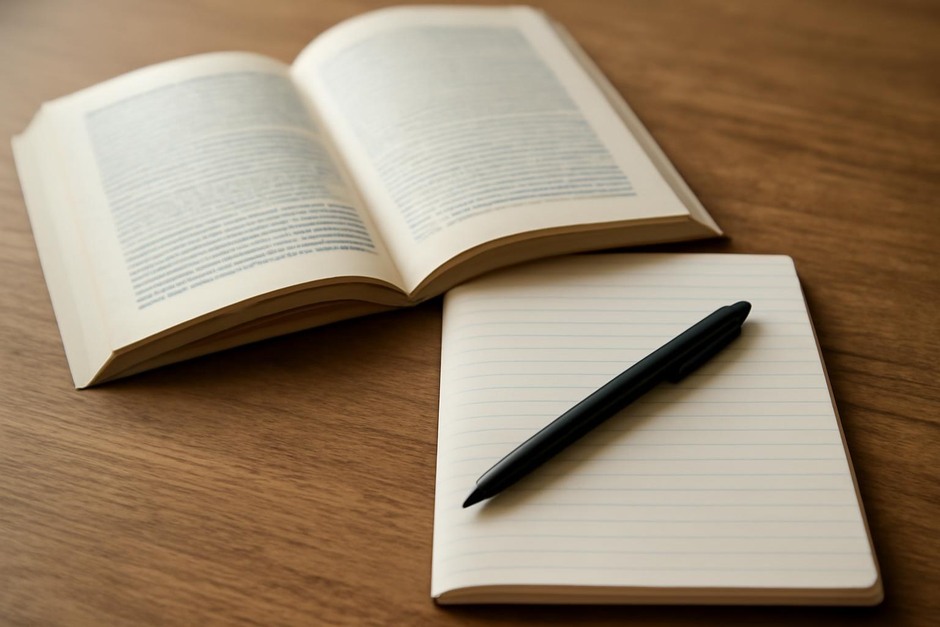
Five Small Reading Experiments to Learn How to Notice and Note
Reading more deeply is less about speed and more about habits of attention. The following five small experiments are designed to be short, repeatable, and cumulative. Each one focuses on one simple action you can take while reading; together they build a lightweight book-journal practice that helps you notice language, patterns, and ideas without turning every book into a project.
Experiment 1 — The One-Sentence Chapter Note (5 minutes per chapter)
After you finish a chapter, write one clear sentence that captures its main movement: a fact, a character decision, or a development in argument. Keep it to one sentence on a single line in your notebook or app.
Common mistake
Trying to summarize every detail of a chapter leads to long, discouraging notes that you won’t read again.
Correction
Limit yourself to one sentence. If you find you must write more, that’s a separate note entitled “Why I wanted more.” Save that extra detail for later reflection, not the chapter capture.
Experiment 2 — Three Lines to Keep (2–10 minutes per session)
While you read, choose up to three lines—phrases, sentences, or short passages—that linger. Copy them verbatim into your journal and add a one-line note about why they mattered: phrasing, image, or an idea.
Common mistake
Highlighting everything that seems nice. When everything is marked, nothing stands out.
Correction
Be selective. If you notice more than three lines, pause and ask: which one would I be disappointed to forget? Start by saving only those.
Experiment 3 — The 50-Page Thesis (10 minutes at the 50-page mark)
At or before page 50 (or the first quarter), write a single-sentence thesis for the book so far: what is it trying to do? This forces you to name structure and intention early.
Common mistake
Waiting until you finish to form a thesis, then finding it hard to name initial intentions or patterns.
Correction
Draft the early thesis as provisional. Return to it later and adjust. The goal is to train your eye to spot direction and to notice when the book changes course.
Experiment 4 — The Pattern List (5–15 minutes, weekly)
Keep a running list of recurring words, images, or ideas you encounter across a book or several books. Add a short note when a pattern intensifies, shifts, or resolves.
Common mistake
Recording patterns as long unchecked lists that lack context.
Correction
Annotate each entry with a brief example—book/page/line—and write one line about what the pattern does (tone, theme, character work). This keeps the list useful and retrievable.
Experiment 5 — The 200-Word Habit (15–25 minutes, after finishing)
When you finish a book, write 200 words that answer two questions: What stayed with you most? How might this matter in your life or work? Keep it short and candid; the aim is practice, not perfection.
Common mistake
Trying to produce a review or summary. That can turn the exercise into a performance rather than a habit.
Correction
Treat this as private thinking aloud. Use first-person notes. If you occasionally want to formalize a review later, you will have the raw material already collected.
How to sequence the experiments
Begin with Experiment 1 and 2 together for the first week. Add Experiment 3 once you reach the 50-page point in a book. Maintain Experiment 4 as a weekly check-in while you read multiple titles. Finish each book with Experiment 5. The practices feed one another: one-sentence chapter notes make the 50-page thesis easier; the three lines help your 200-word habit feel concrete.
Keeping it sustainable
Set a small goal: the experiments should add no more than 15–25 minutes to a typical reading session, and some—like the chapter sentence—take only a minute. Use a small physical notebook or a single simple note in your phone. Resist the urge to create a complex system. Simplicity keeps these experiments alive.
These small, corrective exercises train a single useful skill: the capacity to notice—language, pattern, and intention—and to make those observations portable. Over weeks, the habit of a few deliberate notes turns casual reading into a clearer conversation with the books you choose.